
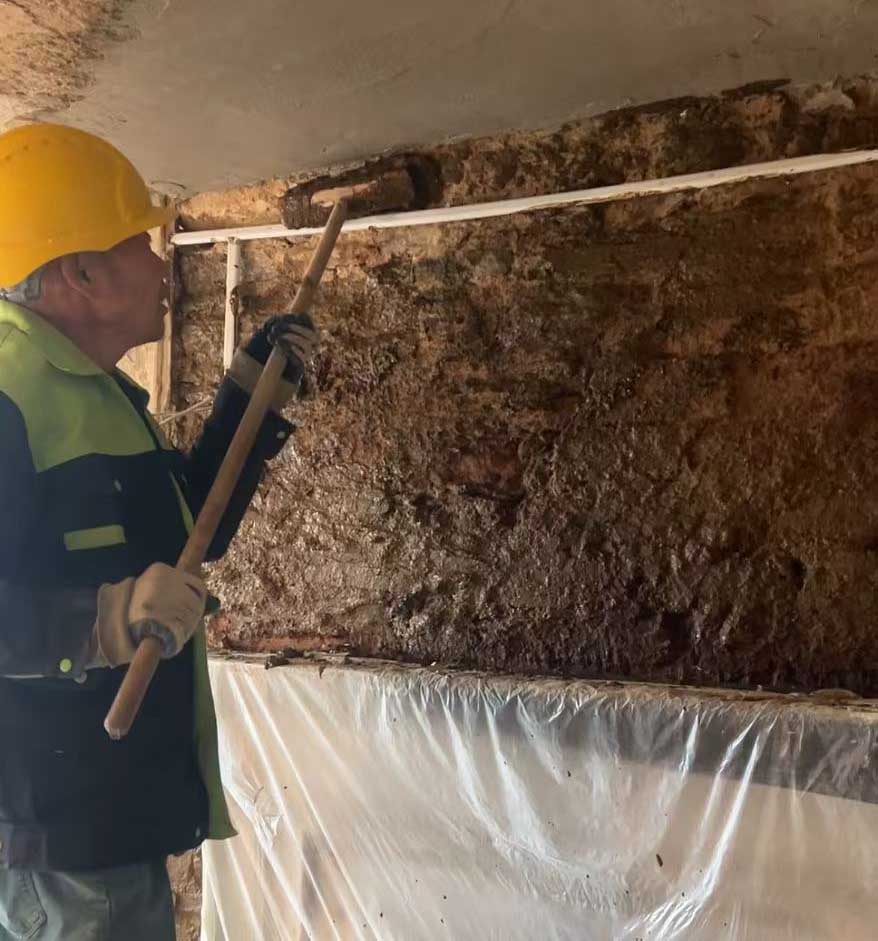
A Practical and Traditional Approach to a Persistent Problem
In the restoration of historic stone buildings across Ireland, one recurring issue is the migration of soot and staining from old chimney breasts and fireplaces. These structures, often centuries old, were exposed to prolonged burning of peat, coal, and timber, leaving deep carbon deposits embedded within the masonry. When modern finishes such as lime plaster are applied, these residues frequently reappear as dark staining—commonly referred to as “soot bleeding.”
While modern chemical sealers exist, they are often incompatible with breathable wall systems. A more traditional and surprisingly effective solution is the use of cow dung plaster as a natural barrier layer.
Why Soot Bleeding Occurs in Old Stone Buildings
Historic fireplaces were never designed with modern finishes in mind. Over decades or centuries:
- Soot penetrates deeply into porous stone and mortar joints
- Oils and carbon compounds remain active within the wall fabric
- Moisture movement (especially in breathable walls) reactivates these deposits
When a new plaster system—particularly lime-based—is applied, the wall continues to “breathe,” allowing these contaminants to migrate to the surface.
Why Cow Dung Works as a Barrier
The use of cow dung in construction is not new. It has been widely used across Europe, Asia, and Africa in traditional building techniques. Its effectiveness comes from a combination of physical and chemical properties:
1. Fibrous Composition
Cow dung contains partially digested plant fibers, which:
- Create a dense, interlocking matrix
- Reduce permeability to soot particles
- Improve adhesion to irregular stone surfaces
2. Natural Enzymes and Bacteria
These components can:
- Stabilize organic residues within the wall
- Reduce ongoing chemical activity of soot compounds
3. Breathability
Unlike modern sealants:
- Cow dung remains vapor-permeable
- It allows the wall to dry naturally
- Prevents trapped moisture, which could otherwise worsen staining or cause decay
4. Slight Alkalinity
This helps neutralize acidic residues commonly found in soot deposits.
Application Method (Best Practice on Site)
From a practical construction standpoint, the success of this method depends heavily on correct preparation and layering.
Step 1: Surface Preparation
- Remove all loose soot, dust, and friable material
- Wire brush the stone surface if necessary
- Do not attempt to fully “clean” the soot—this is often impossible
Step 2: Mixing the Cow Dung Layer
A typical mix:
- Fresh or well-aged cow dung
- Fine sand (optional, for body)
- Small amount of lime (optional, improves durability)
Consistency:
- Similar to a stiff plaster or render coat
- Not too wet (to avoid shrinkage cracking)
Step 3: Application
- Apply a thin but continuous coat (approx. 5–10 mm)
- Ensure full coverage, especially over chimney breast areas
- Press firmly into joints and irregular stone
Step 4: Drying
- Allow to dry naturally (do not force dry)
- Ensure good ventilation
Step 5: Subsequent Finishes
Once fully cured, you can apply:
- Lime plaster (recommended for heritage buildings)
- Hemp-lime plaster (for improved insulation and breathability)
Advantages Over Modern Alternatives
| Traditional Cow Dung Layer | Modern Chemical Sealers |
|---|---|
| Breathable | Often non-breathable |
| Compatible with lime | Can cause delamination |
| Low cost | Expensive |
| Sustainable | Chemical-based |
| Proven historically | Limited long-term data |
Limitations and Considerations
This method is highly effective, but not without constraints:
- It requires acceptance of traditional materials on site
- Skilled application improves results significantly
- Severe oil contamination may require multiple coats
- Not suitable where a completely sterile or modern finish is required
Practical Insight from Irish Restoration Projects
In older Irish properties—particularly rural stone houses—this method has proven especially valuable where:
- Chimney breasts are deeply contaminated
- Lime plaster systems are being retained for breathability
- Conservation principles discourage modern impermeable barriers
In such cases, cow dung acts not just as a barrier, but as a transitional layer between contaminated historic fabric and new breathable finishes.
Conclusion
Cow dung plaster may seem unconventional in modern construction, but in the context of historic building restoration, it represents a highly effective, low-tech solution grounded in centuries of empirical knowledge.
Rather than fighting the natural behavior of old stone walls with impermeable materials, this approach works with the building—maintaining breathability while controlling soot migration.
For builders and renovators working on heritage structures in Ireland, it is a method worth serious consideration—particularly when modern systems fail to deliver long-term results.